Tempe
Heart of the HunterTempe is the setting of Captain Tiger Mazibuko’s confrontation with a paratrooper officer, a public act of violence that begins as retaliation for the officer’s treatment of Little Joe Moroka and later resurfaces as a threat to remove Mazibuko from the pursuit. The place is established through its Parachute Battalion parade ground, where military status, public witnesses, and the consequences of an earlier incident converge.
Military Setting and Public Stage
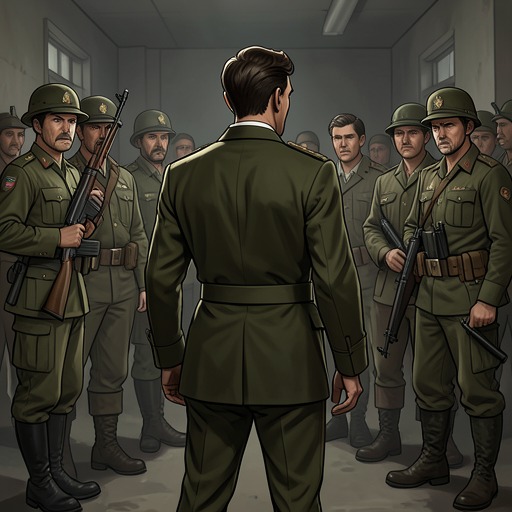
The episode takes place on the Parachute Battalion parade ground at Tempe. Captain Tiger Mazibuko approaches with Little Joe Moroka one step behind him. Four paratroopers are gathered in the shade of a thorn tree, talking rugby; a German Shepherd pants at the feet of their stocky lieutenant in the Bloemfontein heat. The scene’s details place the confrontation in an ordinary, visible military space rather than a private encounter: soldiers sit together under an umbrella, their dog nearby, when Mazibuko strides into their group.
Mazibuko asks whether the lieutenant is the man he is looking for. Once Little Joe confirms it, the captain picks up his pace, red dust rising with each footfall. He steps between the soldiers and kicks the dog hard in the head with his steel-toed combat boot. The animal yelps and staggers against the sergeant’s legs. The lieutenant’s shock turns to anger; he swings at Mazibuko and catches the back of his neck. That blow gives Mazibuko the public justification he has prepared: he announces that the soldiers are witnesses and that the lieutenant struck first.
The Assault and Its Immediate Cause
The stated cause reaches back to what the lieutenant had done to Little Joe that morning: he had set the dog on one of Mazibuko’s men. Mazibuko points back over his shoulder at Little Joe as he explains this grievance. His response is deliberate and controlled in its sequence. After the lieutenant’s wild swing, Mazibuko steps in with a straight punch to draw his attention upward, kicks him in the kneecap, then drives his knee into the man’s face as he topples forward. The lieutenant falls backward with blood streaming from a broken nose.
The exchange leaves the assembled soldiers to witness both the provocation and its consequence. Two paratroopers move closer; the sergeant kneels beside the dog, which lies still. The lieutenant, one hand over his bleeding nose and the other supporting him on the ground, looks at the blood on his hand. Mazibuko ends the confrontation by stating his rule of loyalty: “Nobody fucks with my people,” pointing to the bond with Little Joe that he has invoked as the reason for the assault. The incident makes Tempe the setting where that personal code becomes a public and physically costly act.
Institutional Consequences and Later Reappearance
The confrontation does not remain a private matter between soldiers. The Director later tells Janina Mentz that Mazibuko assaulted a paratrooper at Tempe, put him in hospital, and prompted the commanding officer to call higher up demanding justice. The Director’s report makes clear that the violence has crossed into the military chain of command and become an operational problem. Tempe is therefore linked not only to the assault itself but also to the formal pressure that follows it.
The place returns as leverage when Mentz addresses Mazibuko’s dissatisfaction with his assignment. She warns that if the pursuit is not challenging enough for him, she can send him back to Tempe and find another alternative. This later reference recasts the base as a possible destination away from the fugitive operation, and the earlier assault as a liability that can be used to discipline or redirect him. Tempe’s narrative importance lies in this double function: it is where Mazibuko’s loyalty to Little Joe erupts into violence, and the institutional setting to which he may be returned when that same violence complicates his usefulness.